Requisite Organization
Orgdesign
Requisite Organization
Organizational strata align with time-span of discretion and cognitive complexity for effective management
Contributor:

Serge Tikhonchuk
4 months, 2 weeks ago
Elliot Jaques in his works demonstrated that cognitive complexity of work correlates with time-span of discretion—the maximum temporal period within which a manager can plan and act without external supervision. A CEO of a major institution operates within a 15–20 year time-span, whereas entry-level workers function within days or weeks.[6]
Jaques discovered that organizational roles naturally stratify into eight discrete levels defined by time-span of discretion—the maximum target completion time of the longest tasks in a role. As time-span increases, the "feeling of weight of responsibility" increases proportionally, requiring greater complexity of mental processing to manage effectively. Jaques found through more than 100 studies across different organizations and countries over 35 years that real managerial boundaries occur at specific discontinuous intervals: 3 months, 1 year, 2 years, 5 years, 10 years, and 20 years. This discovery was revolutionary because it revealed that the same organizational principles apply regardless of industry or cultural context, suggesting these boundaries reflect fundamental truths about human cognitive capacity for work.
Four Orders of Cognitive Complexity
Within each time-horizon stratum, Jaques identified four qualitatively different modes of mental processing—Declarative, Cumulative, Serial, and Parallel—that apply recursively across four orders of cognitive complexity: Tangible (concrete), Symbols (symbolic-verbal), Intangible (abstract-conceptual), and Universals (universal principles). Each processing mode represents a different capability: declarative (simple assertions), cumulative (diagnostic accumulation), serial (alternative sequential planning), and parallel (interweaving multiple lines of reasoning simultaneously). These four processing approaches repeat at each order in a fractal pattern, creating a "quadrave" structure where frontline workers operate in Mode 1 of the Symbolic order just as strategic business unit leaders operate in Mode 1 of the Intangible order—using the same cognitive pattern but at increasingly abstract levels.
Matching Role Complexity to Individual Capability
The critical principle of Jaques' framework is the match between required task complexity and individual potential capability. Each individual possesses a maximum cognitive capacity—called their "time horizon" as a person—which represents their potential capability to handle increasingly complex tasks over longer timeframes. When an individual's potential capability exceeds the required complexity of their role, they experience underutilization; conversely, when required complexity exceeds capability, subordinates perceive the manager as ineffective despite higher compensation. The most effective organizational design, which Jaques termed "Requisite Organization," aligns role time-spans with individual cognitive capacity, allowing people to work at their peak potential while ensuring managers can add genuine value by working at higher levels of cognitive and task complexity than their direct reports.
| Order | Processing Level | Role Task & Mental Complexity | Time Horizon | Stratum |
|---|---|---|---|---|
| I -Tangible (Concrete/Specifics) - Childhood world | 1 - Declarative | Simple assertions; one variable at a time | Hours to 1 day | — |
| 2 - Cumulative | Diagnostic accumulation; sort and accumulate information | Days to 1 week | — | |
| 3 - Serial | Alternative serial plans; devise and evaluate paths | Weeks to 1 month | — | |
| 4 - Parallel | Parallel processing; interweave multiple lines | 1-3 months | — | |
| II - Symbols (Symbolic-Verbal) - Adult world | 1 - Declarative | Make unrelated assertions; "This is that" | 1 day - 3 months | I |
| 2 - Cumulative | Related assertions with "and" connections; cumulative support | 3 months - 1 year | II | |
| 3 - Serial | Linear cause-and-effect arguments; alternative plans | 1 - 2 years | III | |
| 4 - Parallel | Interlinked serial arguments; multiple perspectives | 2 - 5 years | IV | |
| III - Intangible (Abstract-Conceptual) - Whole wide world | 1 - Declarative | Concepts about concepts; simple conceptual assertions | 5 - 10 years | V |
| 2 - Cumulative | Related conceptual assertions; systems of ideas | 10 - 20 years | VI | |
| 3 - Serial | Interlinked conceptual cause-and-effect arguments | 20 - 50 years | VII | |
| 4 - Parallel | Complex interweaving of multiple conceptual systems | 50 - 100 years | VIII | |
| IV - Universals (Universal Principles) - Universe of Nature | 1 - Declarative | Thinking about whole societies or worlds | 100+ years | — |
| 2 - Cumulative | Universal paradigms and principles accumulation | 100+ years | — | |
| 3 - Serial | Universal systemic cause-and-effect relationships | 100+ years | — | |
| 4 - Parallel | Integration of universal principles across domains | 100+ years | — |
The Hierarchical Principle: Why Strata Matter
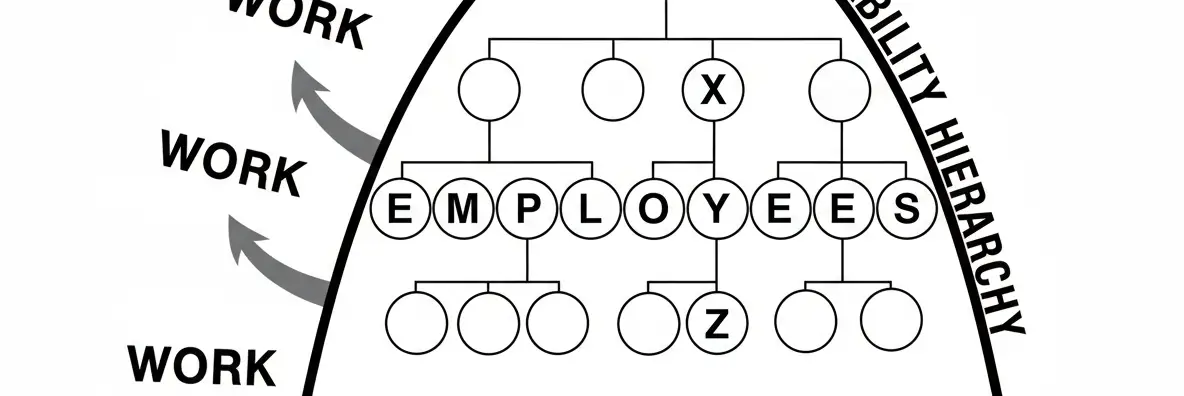
Jaques' concept of Requisite Organization proposes that effective organizational hierarchies must be structured according to natural discontinuities in work complexity, with each stratum representing a distinct level of cognitive and task complexity aligned to a specific time-span of discretion. The fundamental principle is that managers must be at least one stratum higher than their direct subordinates in both cognitive capacity and task complexity, allowing them to add genuine value to subordinates' work; when this principle is violated—such as when managers and subordinates occupy the same layer separated only by pay grade—subordinates perceive their "real" boss as the manager at the genuinely higher level. Jaques discovered through decades of organizational research that the most effective managerial accountability hierarchies cascade accountability vertically through strata, with each level responsible for defining and delegating work to the next lower level, ensuring the right people with necessary capabilities are placed at the right strata to accomplish the organization's mission.
Common Organizational Dysfunction from Structural Abnormalitie
Jaques' framework explicitly addresses the dysfunction created by structural abnormalities such as dual reporting lines, skipped strata, or misaligned hierarchical layers. When an organization attempts to compress hierarchy by skipping strata (for example, having a Stratum III manager report directly to a Stratum V executive, bypassing Stratum IV), or when it creates parallel hierarchies with unclear authority boundaries, conflicts inevitably emerge because subordinates cannot perceive the managerial-once-removed accountability relationships essential for clarity and trust. Similarly, organizations that attempt to flatten structure by removing entire strata discover that the cognitive gap between remaining levels becomes too large, preventing effective delegation and leadership; the missing intermediate layer that was naturally required by the complexity of work must eventually be recreated or the organization suffers dysfunction. Jaques argued that these abnormalities are not rare instances but common organizational pathologies resulting from managers' attempts to reduce span of control or hierarchical levels without understanding that strata are "as required by nature," determined by objective measures of work complexity and time-span rather than arbitrary administrative preferences.
Organizational strata I-IV map to the Symbolic order (concrete-symbolic thinking about specific organizational objectives), while strata V-VIII map to the Intangible order (abstract-conceptual thinking about principles, strategies, and universal business concepts).
| Stratum | Role Examples | Time Horizon | Complexity Description |
|---|---|---|---|
| I | Junior developers, QA testers, technical support specialists, DevOps engineers, data analysts | 1 day - 3 months | Complete one task at a time with specific outputs; linear pathways with concrete thinking |
| II | Team leads, scrum masters, senior developers, systems administrators, security analysts | 3 months - 1 year | Tasks cannot be fully specified beforehand; gather information and refine definitions; theme: Service |
| III | Engineering managers, product managers, technical architects, platform leads, site reliability engineering managers | 1 - 2 years | Prepare multiple alternative solution paths; theme: Practice - optimize resources (budget, people, equipment) |
| IV | Directors of engineering, senior product managers, principal architects, R&D directors | 2 - 5 years | Pursue multiple Stratum III tasks simultaneously; changes require adjustments across paths |
| V | VP of engineering, VP of product, CTO of mid-size companies, heads of platform engineering | 5 - 10 years | Manage complete business units; judge impacts of internal/external events; forecast second- and third-order effects |
| VI | CTO of large enterprises, SVP of engineering, chief product officer, CEOs of scale-ups (1,000-20,000 employees) | 10 - 20 years | Lead multiple business units toward corporate goals; network worldwide to influence organizational events |
| VII | CEOs of tech giants (Meta, Microsoft, Oracle), chief innovation officers of multinational corporations | 20 - 50 years | Assess societal needs nationally/internationally; create business units to meet those needs; highest level in seven-strata organizations |
| VIII | CEOs of mega-tech corporations (Apple, Google, Amazon), founders of transformative tech platforms | 50 - 100 years | Longest-term strategic decisions affecting entire industries and economies; exceptional cognitive capability required |
- 03/12/2026
- 62
Best Goal Setting Apps in 2026: 7 Tools Compared and Ranked
Editor's Pick: If you want one goal setting app …


- 11/14/2025
- 350
4 Simple Questions to Get to Life's Purpose
At some point, we all start wondering: why are we…